
Introduction
Liquid cooling has emerged as a cornerstone of sustainable digital infrastructure in the face of explosive growth in compute demand from artificial intelligence, high-performance computing, and digital services. As rack power densities surpass 40 to 100+ kilowatts and traditional air cooling reaches thermodynamic limits, liquid cooling offers significant energy efficiency gains, water savings, carbon reduction, and operational performance improvements. Search trends and market intelligence identify liquid cooling as one of the fastest-growing segments in data center engineering, with a global market projected to expand from USD 5.3 billion in 2025 to ~USD 20 billion by 2030 at a 24 percent compound annual growth rate.
Executive Overview
Sustainable and liquid cooling infrastructure refers to mechanical and thermal systems that use liquids (water, dielectric fluids) instead of or in conjunction with air to extract heat directly from high-power computing systems. It optimizes energy consumption, enables higher compute density, reduces environmental footprint, and aligns infrastructure growth with corporate sustainability goals and regulatory requirements.
Key Executive Benefits
Organizations deploying liquid cooling achieve up to 30–50 percent energy savings compared with traditional air systems at high rack power densities. Water use reduction reaches up to 90 percent in closed-loop or circular cooling designs versus conventional evaporative or open cooling systems. The technology enables higher ambient coolant temperatures to maximize free cooling and reduce chiller load. Additionally, liquid systems provide better thermal stability and reliability for next-generation accelerators and AI processing units.
This infrastructure evolution is not optional for future digital portfolios. It is a strategic imperative driven by sustainability commitments, energy cost volatility, water scarcity, and regulatory scrutiny.
Energy Savings: 30-50% reduction compared to traditional air cooling at high power densities.
Carbon Impact: 15-21% greenhouse gas emissions reduction over facility lifecycle.
Cooling Load: Cooling energy reduced from 30-40% of facility consumption to minimal levels.
Water Reduction: 90% reduction in closed-loop designs versus open cooling systems.
Circular Systems: 91% reduction in water intake versus traditional cooling.
Potable Water: Significant reduction in reliance on potable water sources in water-stressed regions.
Heat Transfer: Orders of magnitude more efficient than air cooling above 20 kW per rack.
Density Support: Enables 80-120+ kW per rack without thermal throttling.
Stability: Better thermal stability and reliability for next-generation GPU accelerators.
Why Liquid Cooling Matters Now
Rising Compute Density
Modern accelerators and high-performance nodes generate heat flux that traditional air cooling cannot economically dissipate above ~20 kW per rack. Liquid systems outperform air by orders of magnitude in heat transfer efficiency, allowing operators to meet density and performance targets without oversized mechanical systems. GPU clusters and AI infrastructure demand thermal solutions capable of handling 40-100+ kW per rack continuously without performance degradation.
Energy and Emissions
Cooling energy can account for 30–40 percent of facility energy consumption when rack loads exceed traditional thresholds. Liquid cooling reduces the reliance on fans and air handlers, lowering energy draw and carbon footprint. Lifecycle assessments show advanced liquid cooling can cut greenhouse gas emissions by approximately 15–21 percent and reduce blue water consumption by 31–52 percent across a facility's operational life.
Technical Deep Dive: System Architectures
1. Direct-to-Chip Liquid Cooling
This approach uses cold plates and liquid loops that interface directly with high-heat components. Direct-to-chip cooling systems employ manifold networks with redundant pumps, high-grade fittings, and leak detection systems. Dielectric or engineered coolant fluids are selected for thermal performance and materials compatibility.
Direct-to-chip systems can support densities exceeding 80–120 kW per rack without thermal throttling or airflow complications. They integrate seamlessly with existing infrastructure and provide granular thermal control for high-performance computing nodes and AI accelerators.
2. Immersion Cooling
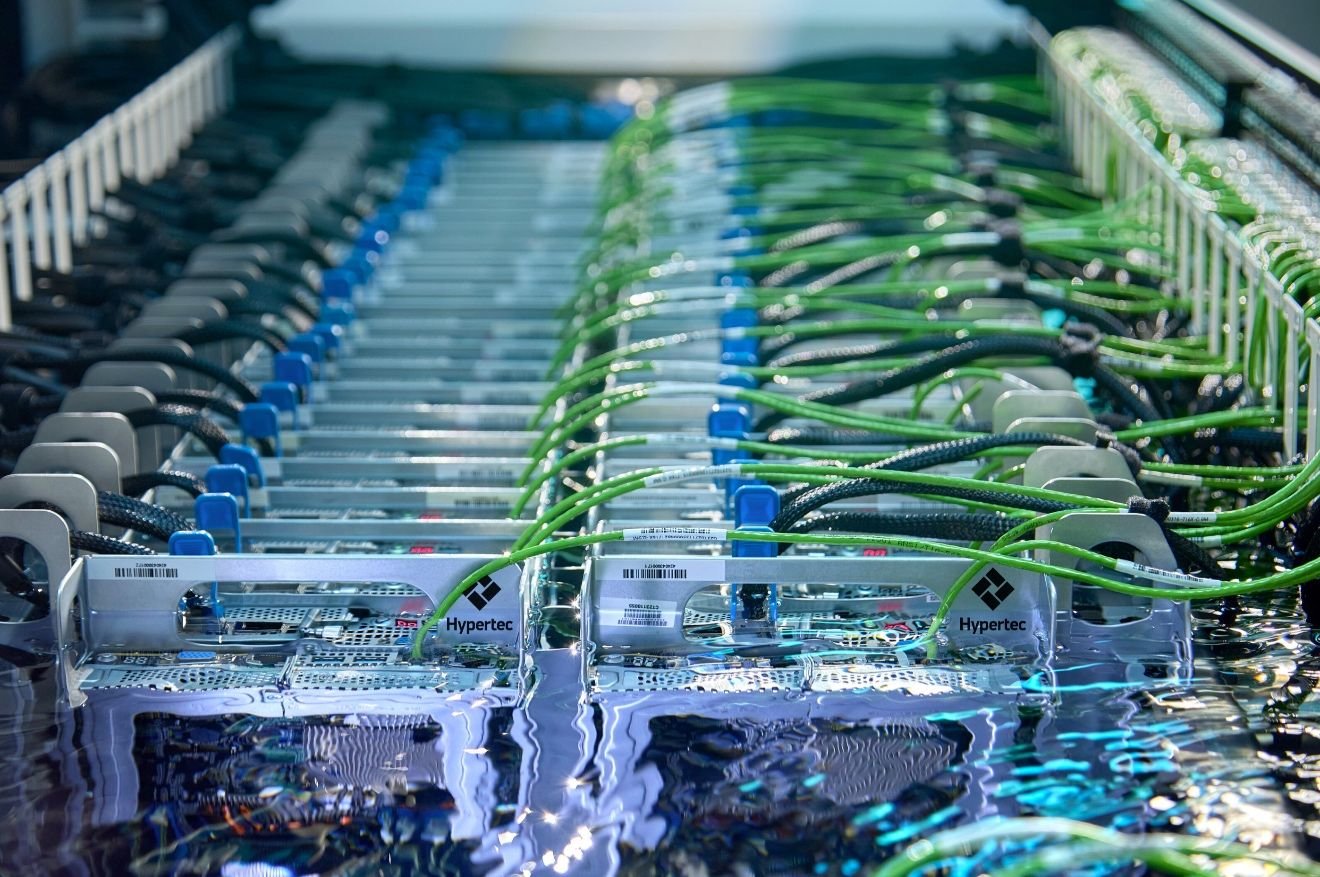
Immersion cooling systems submerge servers in engineered dielectric fluids that remove heat without fans or air circulation. Two main variants exist:
Single-phase immersion uses direct sensible heat transfer through conductive cooling. Two-phase immersion uses latent heat transfer and boiling heat transfer dynamics for extreme cooling efficiency. Immersion options routinely handle 100+ kW per cabinet and can achieve PUE (Power Usage Effectiveness) targets near 1.02–1.05 in optimized deployments.
Waste Heat Reuse and Energy Recovery
Liquid cooling elevates coolant temperatures into ranges suitable for heat reuse in district heating, industrial processes, or domestic water systems. Projects like Aquasar reuse up to 80 percent of expelled heat for campus heating applications, significantly reducing fossil fuel demand and operational costs. This creates a secondary revenue stream through thermal energy monetization and reduces overall facility carbon intensity.
| Cooling Technology | Max Density | PUE Target |
|---|---|---|
| Traditional Air Cooling | ~10-15 kW/rack | 1.67-2.0 |
| Direct-to-Chip Liquid | 80-120 kW/rack | 1.15-1.30 |
| Single-Phase Immersion | 100+ kW/rack | 1.05-1.10 |
| Two-Phase Immersion | 100+ kW/rack | 1.02-1.05 |
Regional Regulatory and Incentive Landscape
North America
Federal and state energy efficiency initiatives increasingly recognize advanced cooling technologies. Recent guidelines encourage adoption of performance standards and efficient cooling solutions, though formal mandates remain under development. Water reuse and circular solutions are gaining traction, particularly in water-stressed Western states, where local utilities partner on industrial reuse projects that treat and recirculate cooling water, significantly reducing reliance on potable systems.
Europe
The Climate Neutral Data Centre Pact sets aggressive energy efficiency, water conservation, and heat reuse targets, pushing signatories to adopt sustainable cooling technologies. The EU also advances energy performance frameworks that elevate energy efficiency in cooling systems and encourage technologies that exceed air cooling baselines. EU directives increasingly mandate sustainability reporting and environmental impact assessments for data center operations.
Asia Pacific
Regulatory pathways emphasize carbon neutrality targets and incentives for electrification efficiency. Many APAC jurisdictions tie incentives to cooling power effectiveness and water usage metrics. Regional sustainability frameworks promote adoption of advanced cooling through tax breaks and subsidies for green infrastructure investments.
Global Policy Initiatives
International guidelines (e.g., U4E and IEA frameworks) are promoting minimum energy performance standards for digital infrastructure and incentives for efficient cooling innovation. Global standards organizations collaborate on technical specifications and best practices for sustainable data center operations.
Market Size: USD 5.3 billion in 2025 projected to USD 20 billion by 2030.
CAGR: >20% compound annual growth rate through 2030.
Drivers: AI/HPC workloads, sustainability mandates, ESG investor criteria, green financing.
Green Finance: Liquid cooling unlocks sustainability-linked loans and green bonds.
ESG Criteria: Meets investor environmental, social, governance performance expectations.
Tax Incentives: Government programs reward sustainable infrastructure investments.
Data Center Pact: EU Climate Neutral Data Centre Pact sets aggressive targets.
Performance Standards: ASHRAE, IEA, U4E frameworks guide minimum efficiency levels.
Water Stewardship: Regional mandates enforce water conservation and circular reuse designs.
Implementation Best Practices
Design for Liquid-Ready from Day One
Greenfield facilities should integrate piping, manifolds, and heat rejection infrastructure early to avoid costly retrofits. Designing with liquid cooling in mind from inception reduces total cost of ownership and enables modular scaling as compute demands grow. Early-stage integration with building mechanical systems ensures optimal energy routing and thermal management.
Monitor and Control
Use IoT and AI-based frameworks to optimize flow rates, detect leaks, and balance thermal conditions in real time. Continuous monitoring systems provide predictive analytics for maintenance scheduling and prevent thermal emergencies through automated response protocols.
Water Management
Apply closed-loop architectures and wastewater reuse strategies to meet community water stewardship expectations. Treatment systems ensure water quality and enable safe recirculation of cooling loops, reducing environmental impact and operational costs simultaneously.
Standardization and Interoperability
Select standardized connectors, fluids, and maintenance protocols to ensure long-term serviceability. Industry standards prevent vendor lock-in and simplify future technology upgrades and equipment replacements.
Financial Impact and ROI
Liquid cooling investments deliver compelling returns through multiple channels. Energy cost reduction of 30-50% translates directly to operational savings over a facility's 15-20 year lifespan. Water cost savings and environmental compliance reduce regulatory risk exposure. Waste heat monetization through district heating or industrial process integration creates secondary revenue streams. Improved compute density enables higher revenue per square foot of data center footprint, multiplying financial impact across large-scale deployments.
Conclusion
Sustainable and liquid cooling infrastructure is no longer an engineering experiment. It stands at the intersection of energy efficiency, environmental stewardship, budget optimization, and compute scalability. For global technology operators contending with rising compute density, regulatory pressures, and ESG performance expectations, liquid cooling represents a measurable pathway to future-proof infrastructure at scale. Its adoption accelerates performance, reduces operational expenditure, and improves sustainability reporting, making it a compelling investment theme for both infrastructure executives and capital allocators.