
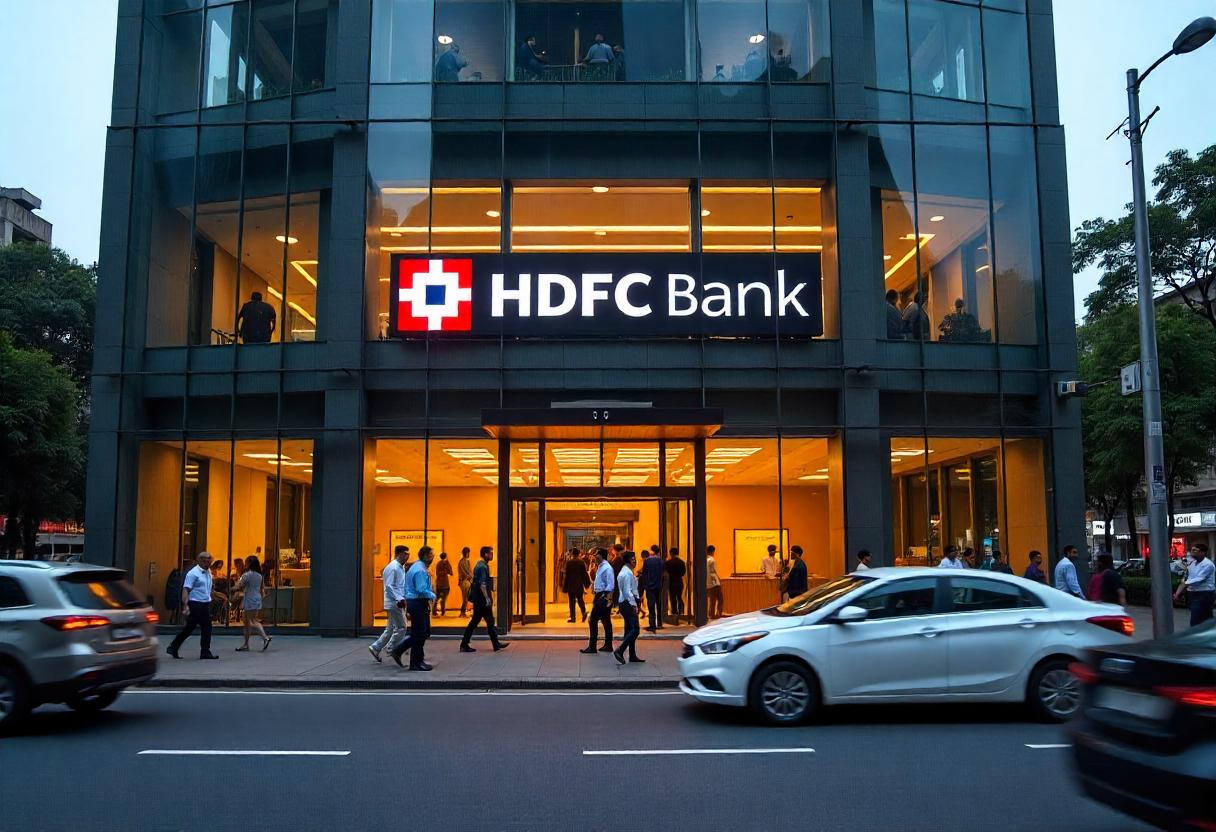
Quick Summary: HDFC Bank AT1 Crisis (2026)
- Market Cap Loss: ₹96,000 crore in 48 hours
- Stock Fall: 8.7%
- P/B Collapse: 4.5x → 1.4x
- Cause: AT1 bond mis-selling to NRI clients
- Impact: Chairman resignation + governance failure
The stability of a domestic systemically important bank (D-SIB) is fundamentally anchored not merely in its Common Equity Tier-1 (CET1) ratios or its liquidity coverage, but in an intangible yet quantifiable asset: the governance premium. For over three decades, HDFC Bank served as the gold standard of Indian private banking, commanding valuation multiples that reflected an implicit market trust in its risk management, conservative credit culture, and ethical frameworks. However, the events of March 2026 have fundamentally challenged this paradigm. The crisis, characterized by the termination of senior leadership, regulatory bans in international jurisdictions, and the abrupt resignation of the non-executive chairman, represents a systemic failure that transcends simple operational lapses. It is an episode where the economics of trust collided with the aggressive pursuit of fee-based income, leading to a market capitalization erosion of approximately ₹96,000 crore within 48 hours.
The Governance Premium and the Mechanics of De-rating
In the valuation of financial institutions, the governance premium represents the excess value investors are willing to pay for a bank's shares above its fundamental book value, based on the belief that its management will act with superior integrity and foresight. At its peak, HDFC Bank traded at Price-to-Book (P/B) ratios of 3.5x to 4.5x, a massive premium compared to its peers. The crisis of 2026 has seen this premium evaporate, with the P/B ratio collapsing toward 1.4x adjusted book value, a level historically reserved for institutions with significant structural risks.
This de-rating is not a reaction to a credit failure or a liquidity crunch; rather, it is a response to the discovery of a "trust deficit" at the core of the institution's wealth management and international operations. The market's reaction suggests that when a D-SIB's chairman resigns citing "ethical differences," the risk model changes from one of "predictable growth" to "uncertain liability".
Why the HDFC AT1 Crisis Matters
- Signals breakdown of governance in India’s largest private bank
- Triggers systemic trust risk in banking sector
- Impacts global investor confidence in Indian financial institutions
- Raises regulatory scrutiny on wealth management practices
Comparative Valuation and Governance Multiples (March 2026)
| Metric | HDFC Bank (Post-Crisis) | ICICI Bank (Benchmark) | Industry Average (Private) |
|---|---|---|---|
| Price-to-Book (P/B) Ratio | 1.4× | 2.4× – 2.5× | 1.8× |
| Price-to-Earnings (P/E) | 15.6× | 18.5× | 17.0× |
| Dividend Yield | 2.91% | 0.75% | 1.50% |
| Market Cap Rank | 1 | 2 | N/A |
HDFC Bank lost ₹96,000 crore in market value within 48 hours due to governance failure and AT1 bond mis-selling.
The data indicates that while HDFC Bank remains the largest lender by assets and market capitalization, it is no longer the most efficiently valued on a per-unit-of-equity basis. ICICI Bank, which has maintained a "boringly good" consistency in its results, has emerged as the new benchmark for institutional stability.
Technical Forensic of the AT1 Instrument: Risk vs. Representation
To understand the 2026 crisis, one must deconstruct the Additional Tier-1 (AT1) bond, the complex hybrid instrument that served as the catalyst for the leadership collapse. Under the Basel III regulatory framework, banks are required to maintain a capital buffer to absorb losses without triggering a total bankruptcy. AT1 bonds were created as a form of "contingent capital" that sits just above common equity in the capital structure but below all other forms of debt.
The mathematical necessity of AT1 bonds is driven by the regulatory requirement for the Capital Adequacy Ratio (CAR), which is formulated as:
CAR = (Tier 1 Capital + Tier 2 Capital) / Risk Weighted Assets
AT1 bonds satisfy the Tier 1 requirement but carry features that make them significantly riskier than traditional bonds. They are perpetual, meaning they have no fixed maturity date, and the bank is under no obligation to repay the principal unless it chooses to exercise a "call option," typically after five years. Most critically, these bonds contain a "bail-in" clause. If the bank's Common Equity Tier-1 (CET1) ratio—calculated as common equity divided by risk-weighted assets—falls below a specific trigger (usually 5.125% or 6.125% depending on the jurisdiction), the principal value of the bonds can be written down to zero permanently.
The inherent risk of these instruments was globalized in March 2023 when the Swiss regulator, FINMA, ordered the write-off of $17 billion dollars of Credit Suisse AT1 bonds as part of its emergency rescue by UBS. This event established a precedent where bondholders were wiped out while shareholders—who traditionally sit lower in the hierarchy—received some value. It was precisely these instruments that HDFC Bank's international branches in Dubai and Bahrain continued to market to conservative retail investors, setting the stage for a catastrophic governance failure.
Hierarchy of Loss Absorption in Bank Capital Structure
| Capital Layer | Primary Instrument | Loss Absorption Trigger | Relative Risk |
|---|---|---|---|
| Common Equity | Common Shares | Continuous | Highest |
| Additional Tier-1 | AT1 Bonds | Regulatory Trigger (Write-down) | Very High |
| Tier-2 Capital | Subordinated Debt | Insolvency / Liquidation | Moderate |
| Senior Debt | Senior Bonds | Liquidation | Low |
| Deposits | Fixed Deposits | Liquidation (Insurance Protected) | Lowest |
What is an AT1 Bond?
AT1 bonds are perpetual bank capital instruments that can be written down to zero if a bank’s capital ratio falls below regulatory thresholds.
What is Governance Premium?
Governance premium is the valuation multiple investors assign to a bank based on trust, transparency, and management credibility.
Why the HDFC AT1 Crisis Matters
- Breakdown of governance in a systemically important bank
- Loss of investor trust in Indian banking sector
- Increased regulatory scrutiny globally
- Long-term valuation de-rating risk
The Dubai-Bahrain Operational Failure: A Study in Regulatory Arbitrage
The crisis did not emerge from a single error but from a multi-year orchestration of regulatory arbitrage. Between 2021 and 2023, HDFC Bank's Dubai International Financial Centre (DIFC) branch and its Bahrain operations became a conduit for moving conservative Indian capital into high-risk Swiss debt.
The mechanics involved targeting Non-Resident Indian (NRI) clients who held Foreign Currency Non-Resident (FCNR) deposits. These deposits are traditionally the safest investment for NRIs, offering fixed terms, guaranteed returns, and protection against exchange rate fluctuations. Relationship managers allegedly persuaded these clients to shift their funds from FCNR accounts in India to the Bahrain branch to facilitate the purchase of Credit Suisse AT1 bonds.
The "mis-selling" was predicated on a total misrepresentation of risk. These perpetual, loss-absorbing instruments were marketed as "fixed-maturity, safe-haven" products with "assured returns" of 10% to 13%. To bypass Dubai's strict investor protection laws, which restrict such products to "sophisticated" or "professional" investors with over $1 million dollars in net worth, bank officials allegedly inflated the income details of clients in official documentation. In several documented cases, clients were asked to sign blank or pre-filled forms, a practice that eliminated the possibility of informed consent regarding the 100% loss potential of the principal.
Forensic Timeline of the AT1 Scandal
| Period | Key Event | Institutional Impact |
|---|---|---|
| 2021 – 2022 | Distribution of Credit Suisse AT1 bonds to NRI clients via Dubai and Bahrain. | Revenue growth in international wealth management. |
| March 2023 | Credit Suisse collapse; $17bn AT1 bonds written to zero by FINMA . | Immediate capital loss for HDFC's NRI clients. |
| Early 2025 | HDFC Bank initiates an internal probe following client complaints. | Two senior executives placed on "gardening leave." |
| July 2025 | Formal complaint filed with the Economic Offences Wing (EOW), Nagpur . | Legal and criminal scrutiny begins in India. |
| September 2025 | Dubai Financial Services Authority (DFSA) bans HDFC Bank from onboarding new clients. | Operational freeze in the Middle East region. |
| March 18, 2026 | Internal investigation concludes; Chairman Atanu Chakraborty resigns. | Market panic; stock hits 52-week low. |
| March 21, 2026 | Three senior executives (Kumar, Gupta, Mandhyan) terminated. | Highest level of operational accountability in the bank's history. |
The Chairman's Resignation: A Crisis of Values and Ethics
The most significant "red flag" for the market was the departure of Atanu Chakraborty, the bank's non-executive chairman, on the night of March 17, 2026. Chakraborty, a veteran bureaucrat and former Economic Affairs Secretary, had served on the board since May 2021. His resignation was not routine; it was a condemnation of the bank's internal culture.
Chakraborty stated in his resignation letter: "Certain happenings and practices within the bank that I have observed over the last two years are not in congruence with my personal values and ethics". The inclusion of the terms "values" and "ethics" in a regulatory filing is catastrophic for a financial institution. It suggests that the failures in Dubai and the AT1 mis-selling were not isolated operational gaps but symptomatic of a deeper, systemic disregard for client protection and regulatory transparency.
Internal reports suggest that the rift between Chakraborty and the executive management team, led by CEO Sashidhar Jagdishan, centered on the concept of "senior accountability". Chakraborty reportedly believed that the senior-most leaders who oversaw the international and retail banking divisions should be held publicly responsible for the regulatory violations in Dubai. The management team, accustomed to a culture of operational autonomy inherited from the Aditya Puri era, resisted this level of board intervention, viewing it as "micromanagement". This "trust deficit" between the board's oversight function and the management's execution function ultimately made Chakraborty's position untenable.
Profile of Accountability: The Three Terminated Executives
The conclusion of the internal investigation on March 18, 2026, led to the immediate termination of three senior executives. The seniority of these individuals confirms that the mis-selling was not the result of a few "rogue" relationship managers but a failure of leadership at the group and regional levels.
Sampath Kumar: Group Head of Branch Banking
Sampath Kumar held one of the most powerful operational roles in the bank, overseeing the entire retail branch network. His termination is significant because it acknowledges "supervisory failure." While he may not have directly pitched the bonds to clients, the culture of aggressive sales targets and the redirection of FCNR funds occurred under his institutional watch. His removal signals that the bank's "accountability sweep" has extended to the highest layers of its execution hierarchy.
Harsh Gupta: EVP, Middle East, Africa, and NRI Business
Harsh Gupta was the executive in direct control of the geography where the mis-selling occurred. The Dubai and Bahrain branches reported to him, and he was allegedly a central figure in orchestrating the sales strategies that targeted NRIs. He had been on leave since early 2025, and his eventual termination reflects the direct evidence of documentation gaps and client misrepresentation found during the probe.
Payal Mandhyan: Senior Vice President
As a Senior Vice President, Payal Mandhyan was responsible for the execution and compliance layers within the Dubai DIFC branch. She was directly implicated in the "onboarding gaps" identified by the Dubai regulator. Her termination, alongside Gupta's, closes the loop on the regional leadership that failed to uphold suitability norms in the UAE market.
Executive Accountability Summary
| Executive | Role | Basis for Termination |
|---|---|---|
| Sampath Kumar | Group Head of Branch Banking | Global supervisory failure and oversight lapse |
| Harsh Gupta | EVP – Middle East & Africa | Direct management responsibility for the mis-selling hub |
| Payal Mandhyan | Senior Vice President | Operational failure in Dubai onboarding processes |
The Regulatory Hammer: Dubai's DFSA and the India-Global Conflict
The Dubai Financial Services Authority (DFSA) took a far more aggressive stance than the Indian regulators, highlighting a significant divergence in global compliance standards. In September 2025, the DFSA prohibited HDFC Bank's DIFC branch from onboarding new clients, citing violations in "advising on financial products" and "arranging credit" for customers who were not formally onboarded.
The regulator's investigation went beyond paperwork; it questioned the very integrity of the "Professional Client" classification. Under UAE law, a Professional Client is assumed to have the expertise to understand high-risk instruments like AT1 bonds. By allegedly inflating client incomes to meet this threshold, HDFC Bank was perceived to have circumvented the core spirit of investor protection. The DFSA's ban effectively halted HDFC's growth in the Middle East, a region that contributes a significant portion of its NRI deposit base.
In India, the Reserve Bank of India (RBI) initially attempted to calm the markets by stating there were "no material concerns" regarding the bank's conduct or financials. However, the market viewed the RBI's reassurance as insufficient given the chairman's "ethics" statement. Furthermore, the Securities and Exchange Board of India (SEBI) has launched a preliminary inquiry into the potential violation of regulations governing directors of listed companies, specifically focusing on whether material disclosures were withheld from shareholders.
Market Impact: The Quantitative Deconstruction of a Sell-off
The financial fallout of the crisis was historic in its scale. Within two days of the chairman's resignation, HDFC Bank's stock fell by 8.7%, wiping out approximately ₹96,000 crore in market capitalization. This sell-off was driven by a massive exodus of Foreign Portfolio Investors (FPIs).
FPIs, who are historically sensitive to governance "red flags," sold Indian financial stocks worth ₹31,831 crore in the first half of March 2026 alone. HDFC Bank, as a heavyweight in the Nifty 50 and a favorite of global pension funds, became the "liquidity tap" for investors looking to exit India amid rising geopolitical tensions and institutional uncertainty.
Stock Performance Snapshot (March 18 - March 24, 2026)
| Date | Closing Price (₹) | Intraday Low (₹) | Market Capitalization Loss (Cumulative) |
|---|---|---|---|
| March 18, 2026 | ₹843.00 | ₹838.00 | Baseline |
| March 19, 2026 | ₹800.00 | ₹770.00 | ~₹55,000 Crore |
| March 20, 2026 | ₹786.95 | ₹781.00 | ~₹96,000 Crore |
| March 23, 2026 | ₹743.75 | ₹740.95 | ~₹1.09 Lakh Crore |
The data shows that the stock price entered a "bear territory" from which recovery is hindered by the "overhang" of ongoing investigations and the vacuum in permanent leadership.
Trust as Economic Capital: The Sociology of a Collapse
The crisis reveals that trust in banking is not a moral abstraction but a functional economic asset. The "Authority Bias" of investors led them to believe that a recommendation from HDFC Bank carried an implicit guarantee of safety. When this trust is betrayed through the "Complexity Illusion"—where complicated products like AT1 bonds are sold to unsophisticated depositors—the psychological damage to the customer base is permanent.
Economically, the collapse of trust manifests in three ways:
- Reduction in Valuation Multiples: Investors no longer provide the "Governance Premium," leading to a permanent de-rating of the P/B ratio.
- Increase in Cost of Capital: The bank must offer higher interest rates on its own debt and deposits to compensate for the perceived institutional risk.
- Customer Churn: NRIs, who were the primary victims of the mis-selling, are likely to shift their low-cost FCNR and NRE deposits to competitors, impacting the bank's Net Interest Margins (NIM).
The crisis also highlights the "Yield Bias" inherent in the current financial environment. Investors seeking 10-13% returns in a low-yield world often ignore the risks of the instruments providing those returns. However, the primary ethical burden remains with the institution to ensure "suitability," a duty that HDFC Bank's international operations fundamentally ignored.
Comparison with the Yes Bank AT1 Crisis (2020)
The HDFC crisis bears striking similarities to the Yes Bank collapse of 2020, where ₹8,400 crore of AT1 bonds were written off to zero as part of a restructuring plan. In that instance, retail investors also claimed they were misled by bank staff who pitched the bonds as "safe" alternatives to fixed deposits. The HDFC crisis differs in its international scope—involving the Dubai regulator and Credit Suisse—but the underlying pathology of mis-selling complex debt to retail clients remains the same.
The recurring nature of these crises suggests that the Indian banking sector faces a systemic challenge in managing the incentives of its relationship managers, whose compensation is often tied to the placement of high-commission structured products rather than the long-term protection of client capital.
HDFC Bank vs Yes Bank AT1 Crisis
- HDFC Bank (2026): ₹96,000 crore market loss, global mis-selling, governance collapse
- Yes Bank (2020): ₹8,400 crore AT1 write-off, domestic restructuring
Strategic Path Forward: Rebuilding the Institutional Halo
For HDFC Bank to recover its standing as a premier global institution, it must transition from a state of "defensive containment" to "radical transparency." The appointment of domestic and international law firms to review Atanu Chakraborty's resignation is a necessary step, but the findings must be made public to satisfy institutional shareholders.
Furthermore, the bank must address the "culture of operational autonomy" that allowed the Dubai mis-selling to go undetected for years. This involves strengthening the board's oversight of international compliance and ensuring that "Values and Ethics" are not just slogans in an annual report but are embedded in the Key Performance Indicators (KPIs) of its senior executives.
The road to ₹1,200 per share—the target price cited by many brokerages—is now a test of credibility rather than a test of credit. The bank's fundamentals remain strong, but in the modern era of banking, a strong balance sheet is useless without a strong reputation. As the 2026 crisis has proven, credibility is the most expensive asset a bank owns, and once it is damaged, it is the most difficult to rebuild.
Conclusion: The Final Reckoning of a D-SIB
The HDFC Bank AT1 bond crisis of 2025-2026 serves as a definitive case study in the vulnerability of even the most respected financial institutions. It demonstrates that the greatest threat to a bank's stability is not always external economic shocks or rising defaults, but internal governance rot. The termination of Sampath Kumar, Harsh Gupta, and Payal Mandhyan represents a significant moment of accountability, but it is the "ethics" warning from Atanu Chakraborty that will linger in the minds of investors.
India is entering a phase of rapid financialization, where retail and NRI participation in complex markets is at an all-time high. In this environment, the "suitability norm" is the most critical defense against systemic instability. HDFC Bank's failure to uphold this norm has cost its shareholders nearly ₹1 lakh crore and has forced a re-evaluation of what it means to be "too big to fail" in the Indian context. The crisis is a reminder that in the world of global finance, transparency is the only protection against the eventual collapse of trust. The bank may recover its stock price in the medium term, but the "Governance Premium" it once enjoyed has been permanently redefined.